For many organisations, DPDP readiness still begins with policies, spreadsheets, questionnaires and manually maintained records.
That may work at a smaller scale. But as personal data spreads across CRM systems, HR platforms, SaaS applications, cloud environments, databases, websites, mobile applications and third-party systems, privacy management becomes far more operational.
A DPO needs visibility into questions such as:
Where does personal data exist?
What categories of personal data are being processed?
Why is it being processed?
Which systems and vendors receive it?
How is consent managed?
What happens when a Data Principal exercises a right?
Which privacy risks remain unresolved?
How are assessments and remediation tracked?
How long should data be retained?
Can the organisation produce evidence of its privacy processes?
This is where privacy technology becomes increasingly important.
A strong DPDP privacy technology stack helps organisations move beyond fragmented documentation and build structured, connected and repeatable privacy operations.
The challenge is no longer simply finding a privacy tool.
It is finding the right capabilities and ensuring they work together.
What Is a DPDP Privacy Technology Stack?
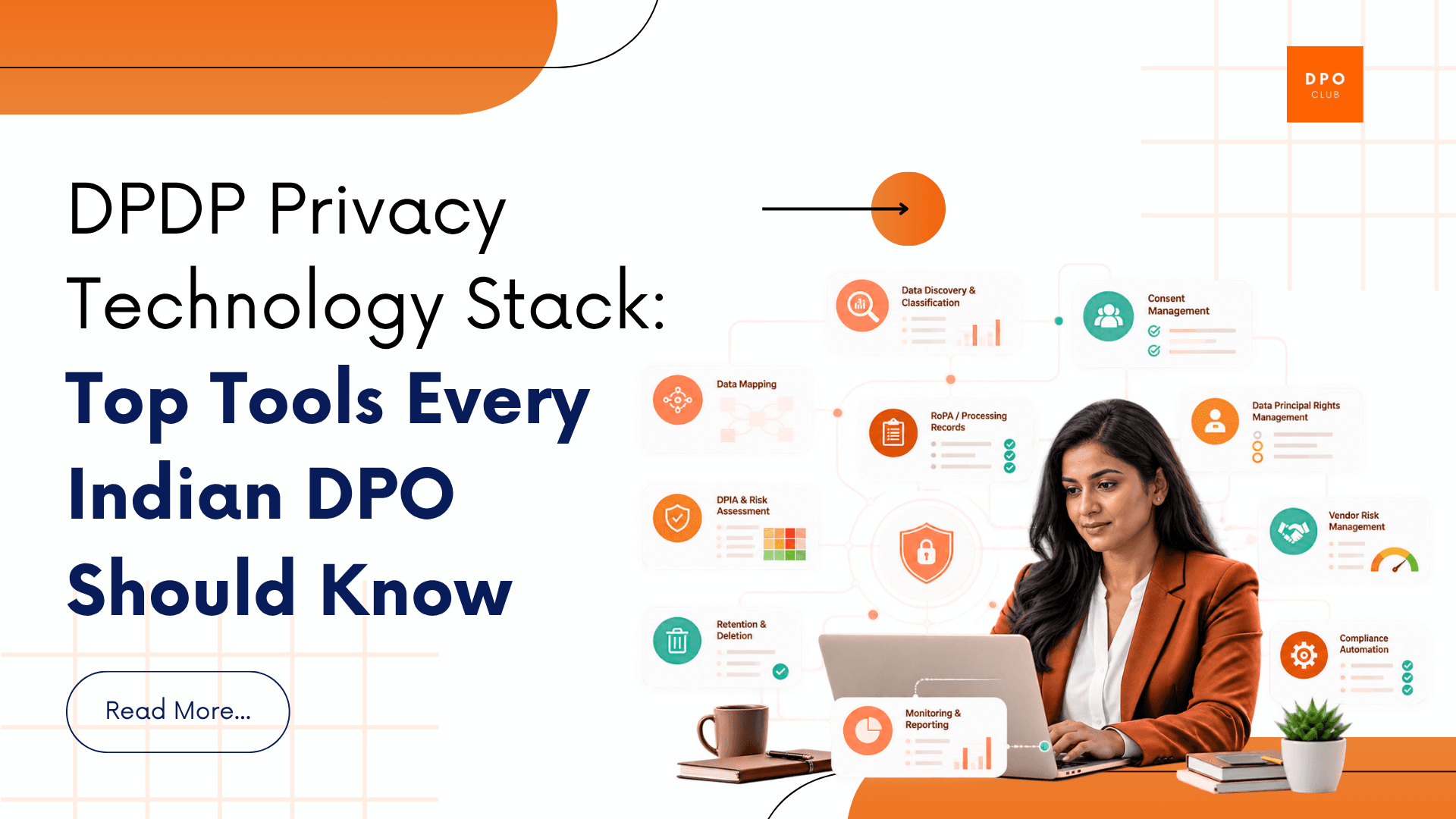
A DPDP privacy technology stack is the combination of tools, platforms and capabilities used to support privacy operations under India’s Digital Personal Data Protection framework. Depending on the organisation, this may include data discovery, data classification, consent management, data mapping, processing inventories, RoPA management, DPIA and privacy risk assessment, Data Principal rights management, vendor risk management, retention and deletion, privacy monitoring and reporting, and compliance workflow automation.
The important word is stack because privacy operations are interconnected. Data discovery supports data mapping, data mapping supports processing records, consent changes may need to flow into connected systems, rights requests depend on knowing where relevant personal data exists, vendor governance depends on understanding which third parties receive data, and risk assessments depend on accurate information about systems, processing activities and data flows.
This is why DPOs should think about privacy technology as an operating ecosystem rather than a collection of isolated compliance tools. The right stack will differ depending on organisation size, sector, scale of processing, volume of personal data, number of applications, number of vendors and processors, cloud and SaaS usage, international operations, risk profile and privacy maturity.
A smaller organisation may need a relatively focused set of tools, while a large enterprise with complex digital operations may require a broader privacy management platform capable of connecting several privacy workflows within a common environment.
Why DPOs Need Privacy Technology
Data is distributed across too many systems
One of the biggest operational privacy challenges is visibility.
Personal data may exist across:
CRM platforms;
HR systems;
marketing applications;
cloud storage;
SaaS products;
customer support platforms;
databases;
websites;
mobile applications;
internal tools;
file repositories; and
third-party systems.
The privacy team may know where data is expected to exist.
That is not always the same as knowing where it actually exists.
This is why data discovery has become such an important part of modern privacy operations.
Manual privacy processes become difficult to scale
Spreadsheets, emails and documents remain useful, but they become a problem when they are expected to function as the privacy operating system.
Consider a common scenario. A vendor assessment sits in a spreadsheet, a DPIA exists in a document, consent information is stored in another application, a Data Principal request arrives by email, retention schedules are maintained separately, and risk remediation is followed up manually. The DPO then has to connect all of these activities.
At scale, this can create duplicate work, inconsistent records, outdated information, delayed follow-ups, poor visibility, difficult reporting and weak auditability. Privacy technology can help convert disconnected activities into structured workflows.
DPOs need evidence, not only policies
Policies explain how an organisation intends to manage privacy, while operational evidence shows what actually happened. A DPO may need to understand what action was taken, who performed it, who approved it, when it was completed, what evidence exists, which risks remain open and which remediation items are overdue.
This is where workflow histories, audit trails, reporting and structured evidence become valuable. A privacy programme becomes more mature when the DPO can move from “We have a process” to “We can show how that process is operating.”
Privacy is cross-functional.
Privacy rarely sits within one department. Legal, compliance, cybersecurity, IT, procurement, HR, marketing, product, customer support and business teams may all process or influence personal data.
This creates coordination challenges. Privacy technology can help through task assignment, workflow routing, approvals, reminders, evidence collection, remediation tracking, dashboards and centralised reporting. The goal is not to remove human judgement; it is to reduce unnecessary manual coordination.
DPOs need connected information
A privacy tool is only as useful as the decisions it enables. A DPO does not need ten dashboards. A DPO needs a clear view of where personal data exists, what risk exists, and what action is still pending.
That is why integration between privacy capabilities matters.
Key Privacy Technology Categories for DPDP
This is where DPOs should focus most of their evaluation. The market includes specialist solutions as well as broader privacy management platforms. Organisations searching for the top DPDP privacy tools in India should evaluate products according to their operational needs, technology environment and privacy maturity.
Feature count alone should not determine the decision. The more useful question is: Can technology solve the privacy problem and connect with the rest of the privacy programme?
1. Data Discovery & Classification
Data discovery is often the foundation of the privacy technology stack because an organisation cannot effectively govern personal data that it cannot locate.
Data discovery tools help identify personal data across enterprise environments such as databases, cloud infrastructure, SaaS applications, file systems, documents, data warehouses, structured datasets and unstructured information. Classification then helps determine what kind of information has been discovered, including names, email addresses, phone numbers, identifiers, financial data, customer information, employee information and organisation-defined categories.
What DPOs should evaluate
When comparing the best data discovery tools in India, DPOs should ask whether the platform can scan the relevant enterprise systems, whether it supports structured and unstructured data, whether custom data patterns can be configured, how effectively discovered information can be classified, whether discovery feeds into data mapping, whether it can support Data Principal rights workflows, whether it can support retention and deletion activities, and whether privacy teams can understand relationships between systems, data and processing activities.
The most useful discovery technology is not simply the one that finds the most information. It is the one that helps the organisation act on what it discovers.
Data discovery without action becomes inventory.
2. Consent Management
Consent management should be treated as a lifecycle rather than a single collection event. A mature consent management capability may support consent collection, consent records, purpose management, preference management, consent changes, withdrawal, evidence, downstream communication and audit history.
The distinction matters. A banner can capture an interaction, but a consent management platform needs to help the organisation understand what happens after that interaction.
DPOs should ask whether consent can be linked to specific purposes, whether preferences can be updated, whether withdrawal can be operationalised, whether consent changes can reach relevant systems, whether evidence is maintained, and whether the organisation can understand current consent status.
When evaluating a DPDP consent management platform, DPOs should consider both the front-end experience and the operational lifecycle behind it.
3. Data Mapping
Data discovery answers “Where is the data?” Data mapping answers “How does it move?”
A data mapping capability can help organisations understand sources, systems, collection points, business functions, data flows, recipients, vendors, processing purposes, storage locations and lifecycle stages.
For DPOs, this provides a more complete view of the processing environment. Static diagrams may work initially, but they become harder to maintain as systems, applications, vendors and processing activities change. Technology can help create more dynamic data maps and connect them to actual privacy workflows.
4. RoPA Management
Many privacy teams maintain structured processing inventories or Records of Processing Activities as part of broader privacy governance. The exact terminology and legal requirements should always be assessed according to the applicable framework rather than automatically importing GDPR concepts into the Indian context.
Operationally, however, maintaining an accurate inventory of processing activities remains valuable. A processing record may capture the processing activity, business owner, purpose, data categories, systems, vendors, recipients, retention, risk information and related assessments.
The main challenge is keeping this information current. A processing inventory becomes much more valuable when it connects with data discovery, data mapping, vendor information, risk assessments and remediation activities. Otherwise, it risks becoming another static spreadsheet.
5. DPIA & Risk Assessment
Privacy risk assessments help organisations identify, evaluate and manage risks arising from processing activities. Technology can support questionnaires, conditional workflows, risk scoring, review processes, approvals, remediation plans, task assignment, documentation, evidence and audit trails.
The objective should not be to automate judgement. It should be to make risk assessment more structured, repeatable and trackable.
A useful privacy risk assessment platform should help answer: What is the risk? Who owns it? What action is required? Has that action been completed?
That is much more valuable than simply producing an assessment report.
6. Data Principal Rights Management
Rights management can quickly become operationally complex, particularly in organisations with large data environments. Technology can help manage request intake, identity verification workflows, request categorisation, routing, task assignment, data search, internal collaboration, response tracking, documentation and audit trails.
One of the most important considerations is integration with data discovery. A request portal may organise a request, but if business teams still need to manually search dozens of systems, the underlying workload remains. This is why discovery and rights management should ideally work together.
A practical example
Consider a retail organisation where customer data is spread across a CRM, e-commerce platform, customer support system, marketing platform and cloud storage. A single Data Principal request may require coordination across several systems and multiple teams.
If rights management and data discovery operate independently, much of the request may still rely on manual searches and follow-ups. When the two are connected, the privacy team can manage the request through a more structured and visible workflow.
7. Vendor Risk Management
Third-party relationships add another layer of privacy complexity. Organisations may work with cloud providers, SaaS companies, payment partners, payroll providers, marketing platforms, agencies, technology vendors and other processors.
A vendor privacy management platform can help manage vendor inventories, questionnaires, assessments, risk scoring, processing relationships, remediation, review cycles, ownership and reporting.
The goal should not simply be to send more questionnaires. The DPO should be able to answer: Which vendors process personal data, what risks have been identified, who owns those risks, and what remains unresolved?
That is the operational value of vendor risk management.
8. Data Retention & Deletion
Retention is closely connected to data discovery because an organisation cannot manage deletion effectively if it does not know where copies of personal data exist.
Privacy technology can support retention schedules, lifecycle rules, deletion workflows, exceptions, approvals, evidence and reporting. For DPOs, retention should therefore be viewed as part of broader data lifecycle governance rather than a standalone policy exercise.
The critical connection is:
Discover → Understand → Retain or Delete
9. Privacy Monitoring & Reporting
Privacy programmes generate large volumes of operational information. DPOs may need visibility into privacy risks, assessments, vendor status, Data Principal requests, consent, remediation, data inventories, processing records and open actions.
Dashboards can help, but dashboards should answer a practical question: What requires attention now?
A useful privacy dashboard should help identify overdue actions, unresolved risks, high-risk vendors, open assessments, request status, remediation trends and areas requiring escalation.
A dashboard without reliable underlying data simply creates a better-looking version of the same visibility problem.
10. Compliance Automation
Automation is the layer that can connect many of these privacy activities. A DPDP compliance automation tool may help organisations automate task assignment, workflow routing, approvals, reminders, escalations, evidence collection, assessment workflows, remediation, request handling, reporting and audit trails.
The real value of automation is not speed alone. It is consistency.
Consider a privacy assessment where a risk is identified, a remediation task is assigned, the responsible owner is notified, the privacy team tracks progress, evidence is attached, the action is reviewed and the workflow history is retained. That is a connected privacy process.
Automation without governance becomes noise.
The best privacy automation should reduce manual friction while giving the DPO better visibility into what requires intervention.
How to Choose Among the Top DPDP Privacy Tools in India
The privacy technology market includes specialist tools and broader privacy platforms.
DPOs evaluating the top DPDP privacy tools in India may come across platforms such as:
GoTrust;
OneTrust;
Securiti.ai;
BigID;
Exterro;
Borneo;
Aurva;
Adaptive;
Optiq; and
other privacy technology providers.
These platforms should not automatically be treated as interchangeable.
Some organisations may need deep functionality in one specific area.
Others may need a broader platform covering several privacy workflows.
A practical evaluation should consider:
Evaluation Area | What the DPO Should Ask |
Data discovery | Can it identify relevant personal data across our environment? |
Classification | Can it accurately classify the data we care about? |
Data mapping | Can it connect systems, data flows and processing activities? |
Consent | Can it manage the consent lifecycle? |
Rights management | Can requests connect with discovery and internal workflows? |
Risk assessments | Can identified risks lead to remediation and tracking? |
Vendor governance | Can vendor risks connect with processing activities? |
Automation | Can repetitive workflows be configured and tracked? |
Integrations | Will it work with our existing technology environment? |
Reporting | Does it help identify what requires action? |
Auditability | Can we demonstrate what happened and when? |
Scalability | Can the platform support increasing organisational complexity? |
This creates a more meaningful comparison than simply counting features.
Specialist Privacy Tools vs Integrated Privacy Platforms
There are two broad approaches.
Specialist Privacy Tools
A specialist platform may focus deeply on one area such as data discovery, consent, vendor risk, rights management or another specific privacy workflow. This can be valuable where an organisation has a highly specific problem requiring specialist depth.
Integrated Privacy Platforms
An integrated privacy platform brings multiple privacy capabilities into a common operating environment. Potential advantages can include fewer disconnected workflows, shared information across privacy processes, consolidated reporting, reduced manual hand-offs, common audit trails and stronger visibility across the privacy programme.
The right question is not “Which model is better?” It is “Which model best fits our privacy operating environment?”
How GoTrust is different from it’s competitors?
Enterprise data privacy platforms like OneTrust, Securiti.ai, and BigID have earned their reputations they're built for global conglomerates with sprawling data estates, dozens of jurisdictions to track, and compliance teams large enough to run a multi-module GRC suite. But that scale comes with a cost: long implementation cycles, six-figure contracts, and platforms often over-engineered for companies that don't operate at that size.
That's the gap GoTrust is built for.
Built for speed, not bureaucracy: OneTrust and Securiti.ai are known for powerful but complex onboarding, data mapping exercises, extensive configuration, and implementation timelines that can stretch for months. For a mid-market company that needs to be compliant now, that timeline is a liability. GoTrust's smaller, more focused platform is designed to get a privacy program operational faster, with less internal overhead and fewer dedicated FTEs required to run it day to day.
Pricing that fits mid-market reality: None of the "big three" publishes pricing, a signal that their deals are negotiated, enterprise-scale, and typically substantial. That works for organizations with dedicated privacy budgets, but it prices out a large segment of companies that still need real compliance coverage: growing SaaS companies, regional enterprises, and businesses expanding into new regulatory territory for the first time. GoTrust's positioning as a leaner, more accessible platform makes privacy compliance achievable for teams without an enterprise-sized budget.
A genuine edge on regional and emerging regulation: OneTrust, Securiti.ai, and BigID are built to cover dozens of jurisdictions at once, which is a strength for global scale, but it also means no single regulation gets specialized treatment. GoTrust, headquartered in India, is positioned to go deep on India's Digital Personal Data Protection Act (DPDP) and broader APAC & EU privacy requirements areas where global platforms often bolt on generic coverage rather than build for local nuance. For companies whose primary compliance exposure is DPDP, or who are expanding into the selective markets and need a platform that understands the law's specific obligations (consent architecture, data fiduciary/processor distinctions, breach notification timelines), that regional depth can matter more than breadth across 40 jurisdictions they'll never operate in.
Closer, more responsive support: As a smaller, younger vendor, GoTrust has an opportunity that enterprise platforms structurally can't offer at scale: hands-on, high-touch support where customers aren't one thousand accounts. For teams without a large in-house privacy function, that kind of responsiveness can be the difference between a platform that gets configured once and ignored, and one that gets used correctly.
What Should DPOs Take Away?
A privacy platform should not be selected because it has the longest feature list. It should be selected because it solves the organisation’s operational privacy problems.
DPOs should ask whether they can discover personal data, understand where it moves, maintain accurate processing information, manage consent and preferences, operationalise Data Principal rights, assess privacy risks, govern third parties, manage retention and deletion, track remediation, produce meaningful reports, automate repetitive privacy workflows and, most importantly, determine whether these capabilities can work together.
That final question may be the most important.
The privacy stack problem is increasingly not a lack of tools. It is a lack of connection between them.
Conclusion
DPDP readiness cannot remain only a policy, spreadsheet or documentation exercise. As organisations process more personal data across increasingly complex technology environments, DPOs need better visibility into data, processing activities, consent, rights, vendors, risks, retention and remediation.
That is the real purpose of a DPDP privacy technology stack.
The strongest privacy technology strategy is not necessarily the one with the most software. It is the one that connects the right capabilities, reduces operational friction and gives privacy teams better visibility and control.
For organisations evaluating the top DPDP privacy tools in India, the best data discovery tools in India, or a broader DPDP compliance automation tool, the most useful question is: Does this technology solve one privacy problem or can it help connect the privacy programme as a whole?
For organisations seeking a more integrated approach, platforms such as GoTrust can be considered as part of the broader privacy technology evaluation.
Frequently Asked Questions
What is a DPDP privacy technology stack?
A DPDP privacy technology stack is the combination of tools and capabilities used to support privacy operations such as data discovery, consent management, data mapping, risk assessments, rights management, vendor governance, retention, reporting and workflow automation.
What are the top DPDP privacy tools in India?
The market includes specialist and integrated platforms such as GoTrust, OneTrust, Securiti.ai, BigID, Exterro and other privacy technology providers. DPOs should compare platforms according to their own privacy requirements, data environment, integration needs and operating model rather than relying on feature count alone.
What are the best data discovery tools in India?
The best data discovery tool depends on the organisation’s environment. DPOs should evaluate connector coverage, structured and unstructured discovery, classification, custom detection, scalability and how effectively discovery connects with rights management, data mapping, retention and other privacy workflows.
What is a DPDP compliance automation tool?
A DPDP compliance automation tool helps organisations automate privacy workflows such as assessments, task assignment, approvals, reminders, request handling, remediation, reporting and audit trails.
Can privacy compliance be completely automated?
No. Technology can automate workflow-driven and repetitive activities, but governance, legal interpretation, risk decisions, organisational accountability and human judgement remain essential.
Why is data discovery important for privacy management?
Data discovery helps organisations understand where personal data actually exists. This visibility can support data mapping, rights requests, risk assessment, retention, deletion and broader privacy governance.
What is the difference between a privacy tool and a privacy management platform?
A privacy tool may focus on a specific function such as discovery or consent. A broader privacy management platform connects multiple privacy processes within a common operating environment.
What should a DPO evaluate before buying privacy technology?
DPOs should assess data discovery, integration, workflow automation, rights management, consent, risk assessment, vendor governance, reporting, auditability, scalability, security and how well different capabilities work together.