Concept Note
The study proposes to examine the environmental impact of developing and deploying Artificial Intelligence (AI) in India and critically assess whether current Indian policy frameworks adequately address the energy consumption patterns and ecological implications of AI systems.
The study aims to document the energy demands and carbon emissions while developing and deploying AI systems in India. The AI systems under study would include Large Language Models (LLMs), Generative AI and AI-integrated cloud platforms.(Strubell et al., 2019; Patterson et al., 2021).1,2 It will also examine India’s AI strategy policy documents in order to assess the policy and regulatory gaps that currently exist and whether the environmental impact caused by AI is being addressed or not. As AI systems increasingly rely on large-scale datasets, practices such as data minimization, retention limits, and storage optimization become critical not only from a governance perspective but also as mechanisms to reduce environmental impact.³
The stakeholder perceptions from Indian AI startups will help in understanding how they perceive environmental impact and whether sustainability is an integral part of their design and operational choices and their views on regulating AI usage. The end of the study will try to derive international best practices and how the same can be tweaked and applied to India in order to develop a Green AI Governance Framework. This approach will help in identifying various policy mechanisms that are currently operational as well as proposed by various countries.
Methodology and Measurement Approach
The study will adopt a mixed-methods approach, combining qualitative insights with quantitative estimation techniques to ensure both empirical grounding and policy relevance.
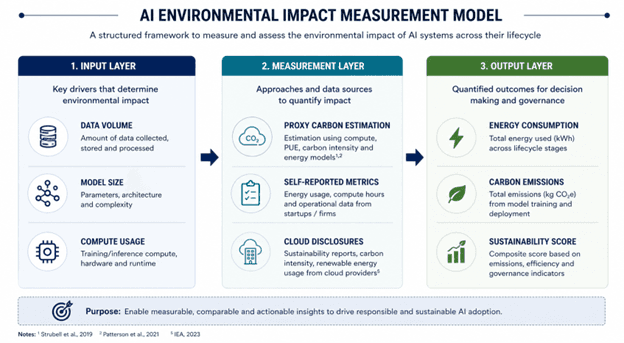
To assess environmental impact, the study will rely on multiple measurement approaches:
Proxy-based carbon estimation, drawing from established methodologies 1,2
Self-reported energy and compute usage metrics collected from AI startups and firms
Public cloud sustainability disclosures, including energy efficiency, carbon intensity, and infrastructure-level reporting 5
Scope and Sampling Framework
The study will focus on a representative sample of Indian AI startups and ecosystem stakeholders, with an indicative sample covering:
Startups across early-stage to scale-stage categories
AI systems across training and deployment phases
Sectoral focus including healthcare, fintech, governance, and consumer AI
Geographic spread across Bengaluru, Chennai, Delhi, Hyderabad, and Pune
Regulatory and Policy Mapping
The study will examine India’s AI strategy policy documents in order to assess the policy and regulatory gaps that currently exist and whether the environmental impact caused by AI is being addressed or not. This will include a regulatory mapping of existing frameworks, such as the Digital Personal Data Protection Act (DPDPA) 4, global standards like GDPR 3, and emerging ESG disclosure frameworks, to evaluate whether sustainability considerations are embedded within current legal and policy instruments.
Stakeholder Engagement
The stakeholder perceptions from Indian AI startups will help in understanding how they perceive environmental impact and whether sustainability is an integral part of their design and operational choices and their views on regulating AI usage.
This engagement will be expanded to include:
AI startup founders, engineers, and policy leads
Cloud service providers and data centre operators
Government AI procurement officials (where accessible)
Sustainability and ESG officers within organizations
Regulators and standards-setting bodies
The study will also explore vendor and cloud ecosystem dependencies, including vendor sustainability commitments, green Service Level Agreements (SLAs), and carbon accountability across the AI supply chain.5
Organisational Accountability and Governance
The study will examine how environmental sustainability in AI can be linked to organizational accountability mechanisms, including:
Board-level oversight on AI sustainability risks
Internal audits and reporting on AI energy usage and emissions
Integration of sustainability metrics into risk management and compliance frameworks
Policy Relevance and Significance of the Study
This study attempts to respond to a critical blind spot that exists in India’s AI policy space, i.e., the lack of attention towards the robust use of AI and its impact on the environment. It also aims to provide an exhaustive review of the existing policy literature at the global and national levels and draw possible best practices to develop a green governance framework that promotes sustainable and innovative use of AI.
While IndiaAI and other related missions focus on enhancing the innovation of computing facilities, there is little importance given to mentioning energy usage, tracking energy emissions, and sustainable use of AI. At COP26, India set itself the ambitious target of achieving net zero carbon emissions by 2070. Fulfilling this target will require critical sectors such as power, industry, and transport to switch from current production methods to low-carbon technologies. Therefore, it becomes imperative to understand the environmental impact caused by rising AI usage.
This study could inform next-generation digital regulations that embed sustainability by design, for example, carbon audits, green disclosures in AI training, deployment, and usage, etc. Interviews that will be conducted with founders, engineers, policy leads, and analysts from AI startups and cloud service providers from Bengaluru, Chennai, and Delhi can give a preliminary level of insight into what possible carbon-based incentives can be introduced to foster green innovation.
Taking support from international best practices, the study will aim to come up with a comprehensive Green AI Governance Framework 6 that will suit India’s social, economic, environmental and business needs to simultaneously promote innovation and environmental sustainability.
Sustainable Data Governance as an Enabler
The study will further explore sustainable data governance, where traditional data protection principles can act as enablers of environmental sustainability:
Data minimization reduces computational load and energy usage³
Retention policies lower storage-related emissions³
Purpose limitation avoids unnecessary model training cycles³
These principles demonstrate that privacy and sustainability objectives can be aligned within AI governance frameworks.
References:
AI Energy & Environmental Impact
Data Governance & Sustainability Link
India Legal & Policy Framework
Cloud, Vendor Sustainability & Infrastructure
Green AI & Trade-offs